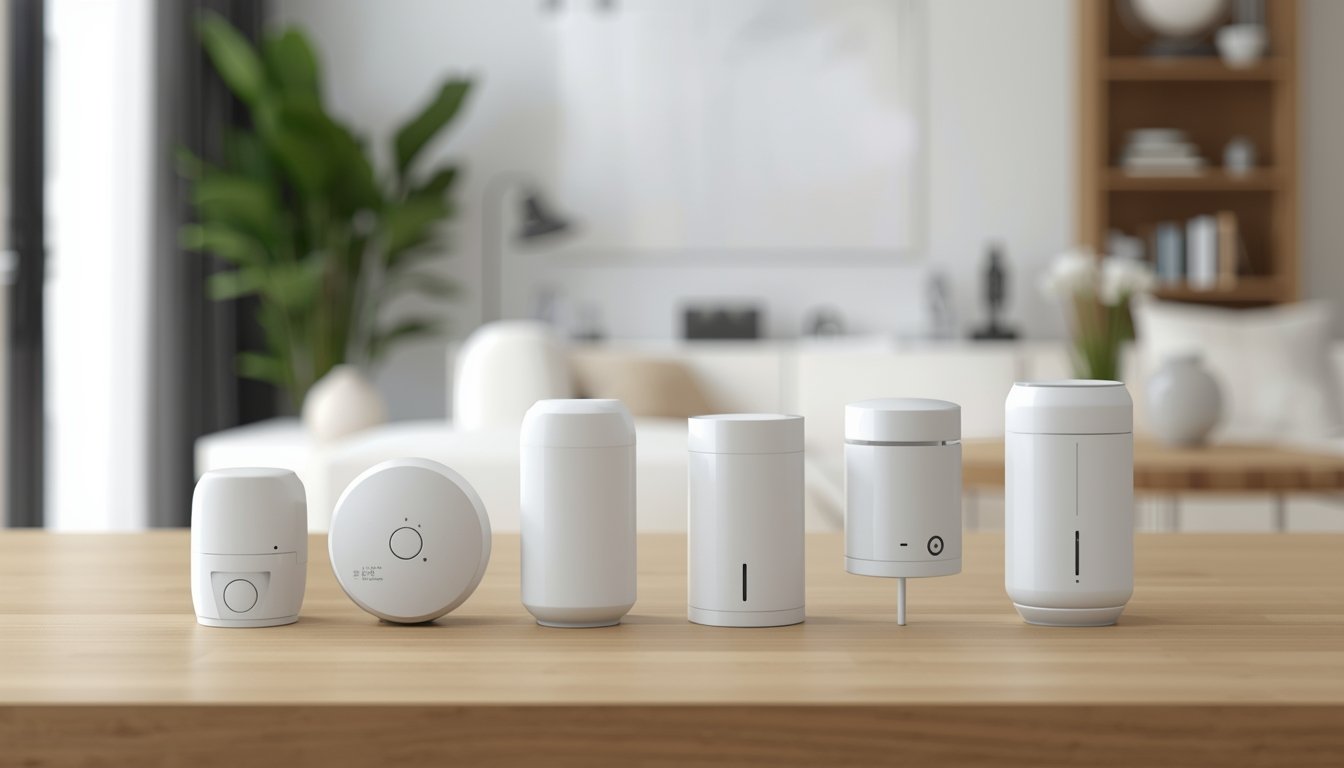
Choosing between water leak detectors is less about finding one universal best model and more about matching the device to the way you want to monitor your home. Some are better for simple cabinet or appliance protection, some are stronger for multi-room coverage, and others are more useful when you want smart alerts or cable-style detection along a wider area. Looking at them side by side makes it easier to see which option actually fits your setup.
Quick Picks
- Best overall for broad home protection: 5 Pack Water Leak Detectors for Home (WD60)
- Best for app-based monitoring in kitchens and laundries: TP-Link Tapo T300 Smart Water Leak Sensor
- Best for larger quiet monitoring zones: Eve Water Guard
- Best budget option for simple cabinet protection: General Tools WA500 Water Leak Alarm
- Best for awkward layouts and hard-to-reach edges: Mengshen WiFi Water Leak Detector with Cable Sensor
TP-Link Tapo T300 Smart Water Leak Sensor Review

A compact smart leak sensor designed for people who want app-based alerts in high-risk areas such as kitchens, laundries, and utility spaces.
This detector stands out if your priority is being notified quickly when you are not standing nearby. A basic alarm can help when you are at home, but a smart sensor makes more sense when you want to know about a leak even if it starts while you are away. That makes it a practical fit for busy households or for areas that are not checked often.
It is also a better match for users who prefer targeted coverage in one or two important locations rather than broad coverage across the whole house. In that role, it works well as a focused sensor for areas where early notice matters most, such as under a kitchen sink or near a washing machine connection.
Best for: smart alerts in key rooms where remote monitoring matters.
Advantage: stronger for remote awareness than a basic standalone alarm.
Limitation: less useful as a whole-home solution unless you add more sensors.
General Tools WA500 Water Leak Alarm Review

A straightforward leak alarm for simple protection under sinks, beside toilets, or near appliances where you want a clear local warning without extra setup.
This is the most direct option in the group. It suits homeowners who do not need app features, longer sensing cables, or a multi-room package. If the goal is to place a detector in one vulnerable spot and get an immediate audible alert, this type of product stays practical and easy to manage.
Its main strength is simplicity. That makes it well suited to smaller jobs such as cabinet protection or appliance-side placement. At the same time, that simplicity means it is not the strongest choice if you want broader monitoring or more flexible placement options.
Best for: low-cost protection in small, obvious risk areas.
Advantage: easy to place and easy to understand.
Limitation: local alarm only is more limited than smart monitoring.
5 Pack Water Leak Detectors for Home (WD60) Review

A multi-pack water leak detector set designed for households that want to cover several leak-prone areas at the same time rather than protect only one location.
This is the most practical overall option for many homes because leak risk is rarely limited to one room. A kitchen sink, dishwasher space, laundry area, water heater corner, and bathroom vanity can all become problem spots. A multi-pack helps you cover those areas from the start instead of buying separate units later.
It is not the most advanced single device in the group, but it delivers strong value through coverage. That makes it a better fit for households that want broad protection across multiple locations rather than a premium setup focused on one zone.
Best for: households that want simple protection across several rooms.
Advantage: better starting coverage than buying one detector at a time.
Limitation: individual units are less specialised than premium smart options.
Eve Water Guard Review

A premium water leak detector that uses an extended sensing cable to monitor larger spaces where water may spread along a floor edge or wall line.
This model makes more sense when a leak might not appear in one neat point. In a basement, utility room, or appliance area, water can travel before it becomes obvious. A longer sensing zone gives it an advantage in those wider spaces, especially where you want quieter, more continuous monitoring.
Compared with simpler point-style detectors, it is more specialised. That is useful in the right setup, but it also means it will not always be the best match for a basic cabinet or toilet-base placement where a cheaper alarm can do the job.
Best for: larger areas where broader sensing coverage is more useful.
Advantage: better suited to long edges and wider leak-prone zones.
Limitation: often more than you need for single-point protection.
Mengshen WiFi Water Leak Detector with Cable Sensor Review

A WiFi-enabled leak detector with cable-style sensing for awkward spaces, utility edges, and areas where water may travel along a path rather than collect in one point.
This option sits between a smart point detector and a broader cable-based system. It is especially useful where layout is the problem. Behind storage, around sump-related areas, or near longer pipe runs, a cable sensor can cover spaces that a small point detector may miss.
Its strength is flexibility. That makes it a better choice for irregular areas than a standard compact alarm. On the other hand, if your home only needs basic under-sink protection, a simpler detector may be easier and more cost-effective.
Best for: hard-to-reach layouts where point-only detection is not enough.
Advantage: combines flexible cable sensing with smart monitoring.
Limitation: less necessary for simple cabinet or appliance placements.
Comparison Summary
- The TP-Link Tapo T300 is the strongest fit for targeted smart monitoring in important rooms.
- The General Tools WA500 is the simplest option for low-cost protection in smaller spaces.
- The 5 Pack Water Leak Detectors for Home (WD60) offers the broadest practical starting coverage for most households.
- The Eve Water Guard is better suited to larger monitored areas where water may spread along a wider zone.
- The Mengshen WiFi Water Leak Detector with Cable Sensor is the most flexible option for awkward layouts and hard-to-reach edges.
Final Verdict
For most homes, the 5 Pack Water Leak Detectors for Home (WD60) is the most practical overall choice because it protects multiple risk areas at once. The TP-Link Tapo T300 is the better fit if you want app-based alerts in one or two key locations. The General Tools WA500 works well for simple low-cost placement, while the Eve Water Guard and Mengshen WiFi Water Leak Detector with Cable Sensor are more specialised options for larger or more awkward spaces. The best review takeaway is that the right detector depends on whether your priority is simplicity, coverage, remote alerts, or flexibility of placement.