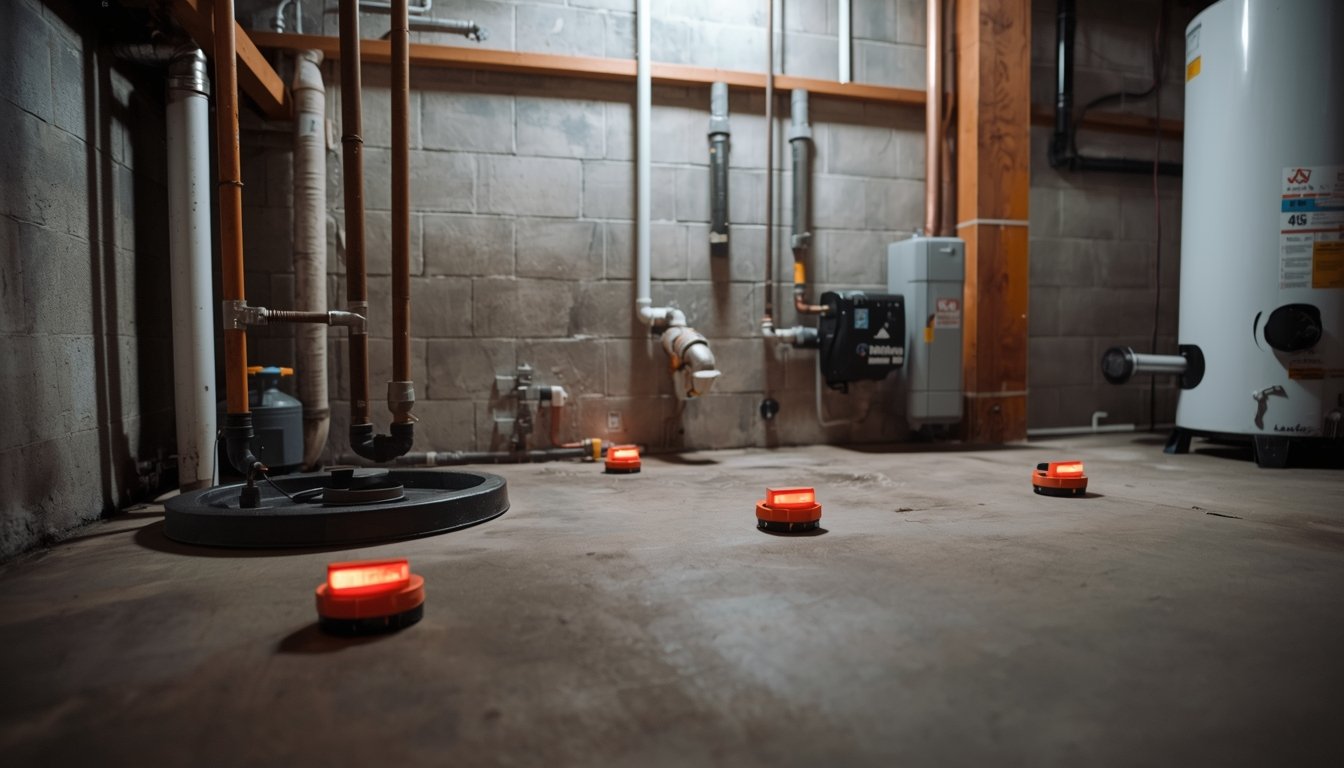
Basements can be one of the hardest parts of a home to monitor for water problems because leaks often start slowly and may not be noticed straight away. Water can appear near foundation walls, sump areas, utility corners, water heaters, or along floor edges where it is easy to miss. The best water leak detector for a basement depends on whether you need simple point detection, broader coverage across several areas, or a cable-style sensor that can monitor a longer path.
Quick Picks
- Best overall for basement coverage: 5 Pack Water Leak Detectors for Home (WD60)
- Best for sump areas and awkward corners: Mengshen WiFi Water Leak Detector with Cable Sensor
- Best for long basement wall edges: Eve Water Guard
- Best budget option for simple basement protection: General Tools WA500 Water Leak Alarm
- Best for remote alerts near basement appliances: TP-Link Tapo T300 Smart Water Leak Sensor
TP-Link Tapo T300 Smart Water Leak Sensor

A compact smart sensor designed for homeowners who want phone alerts when water appears near basement appliances or plumbing connections.
This is a practical basement choice when the risk is tied to one or two clear points, such as a water heater, washing machine connection, utility sink, or pipe junction. Instead of relying only on a local alarm, it is positioned here for people who want a remote alert if water appears while they are upstairs or away from home.
It works best in targeted basement setups rather than along long foundation walls or across several corners. In that role, it is useful for focused monitoring where fast phone notification matters more than wide physical coverage.
Best for: remote alerts near basement appliances and plumbing points.
Advantage: better awareness when the basement is not checked often.
Limitation: less suited to broad basement coverage without extra sensors.
General Tools WA500 Water Leak Alarm

A straightforward leak alarm for simple basement placement in one small area where you want an audible warning without extra setup.
This is the budget option for basements where you mainly want to cover one obvious spot, such as beside a water heater, near a floor drain issue, or next to a utility sink cabinet. It does not try to handle every basement layout. Instead, it is aimed at low-cost point detection.
That makes it a sensible starting point if you want simple protection and you are not looking for app alerts or longer cable sensing. It is less useful in larger basements where water could spread beyond one exact point before you notice it.
Best for: small spot checks in one clear basement risk area.
Advantage: simple and lower cost for basic local warning.
Limitation: not ideal for larger basements or hidden spread paths.
5 Pack Water Leak Detectors for Home (WD60)

A multi-pack detector set that works well when a basement has several possible leak points instead of just one obvious problem area.
This is the strongest overall basement fit because many basements do not have just one risk zone. You may want a detector near the water heater, another by the sump area, one along a wall where seepage sometimes appears, and one near stored appliances or plumbing runs. A multi-pack suits that kind of layout better than relying on a single detector.
It is positioned here as the most practical option for broad basement planning. Even if each unit is simple, wider placement can matter more in a basement than having advanced features in only one location.
Best for: covering multiple basement risk points at the same time.
Advantage: better overall coverage for larger or more complex basements.
Limitation: individual units are less specialised than cable-style systems.
Eve Water Guard

A premium detector with a long sensing cable that is better suited to basement wall lines, floor edges, and wider utility spaces.
This type of product fits basement conditions well because water in a basement often travels along a wall, across a floor edge, or through a longer utility zone before it becomes obvious. A cable sensor is useful in those situations because it can monitor more than one single point.
It is the better match when you already know your basement problem tends to spread along a line rather than pool in one neat spot. That makes it more targeted than a multi-pack, but stronger for specific long-edge monitoring.
Best for: long basement wall edges and utility zones where water may travel.
Advantage: broader sensing across a longer path than point detectors.
Limitation: more specialised than necessary for a simple single leak point.
Mengshen WiFi Water Leak Detector with Cable Sensor

A WiFi-enabled detector with cable sensing that suits sump areas, awkward basement corners, and layouts where water may follow a less predictable path.
This is one of the strongest basement-specific fits in the group because it combines two useful features for this environment: remote alerts and flexible cable-based sensing. Basements often have corners, sump areas, stored items, and awkward access points where a standard point sensor may not be enough.
It is positioned here for homeowners who want better coverage in those harder-to-monitor areas without giving up the benefit of phone alerts. That makes it especially useful in basements that are finished, rarely checked, or have recurring dampness in difficult spots.
Best for: sump areas, awkward corners, and remote basement monitoring.
Advantage: combines flexible cable sensing with WiFi alerts.
Limitation: more setup-focused than a simple drop-in alarm.
How to Choose
- Choose a multi-pack if your basement has several likely leak points, such as a sump area, water heater, foundation wall, and utility corner.
- Choose a cable-style detector if water tends to spread along a wall line or floor edge rather than collecting in one obvious point.
- Choose a smart detector if you do not go into the basement often and want alerts while you are elsewhere in the house or away.
- Choose a basic standalone alarm if you only need low-cost protection in one small and easy-to-check area.
- Think about whether your basement risk is a single appliance leak, a seepage problem, or a wider dampness issue, because each setup needs a different type of detector.
Final Recommendation
For most basements, the 5 Pack Water Leak Detectors for Home (WD60) is the best overall choice because it gives you practical coverage across multiple risk areas instead of forcing you to rely on one detector. If your basement has awkward corners or a sump area, the Mengshen WiFi Water Leak Detector with Cable Sensor is the better targeted fit. If water tends to move along a wall or floor edge, the Eve Water Guard makes more sense. The TP-Link Tapo T300 is a good choice for remote alerts near one key appliance, while the General Tools WA500 is the simplest low-cost option for one small basement spot.